

News Details
Manual hydraulic handling vehicles and cargo handling tools improve work efficiency
In logistics warehousing, supermarket distribution, factory workshops and other scenarios, manual hydraulic handling vehicles have become an indispensable tool for cargo handling due to their flexible and efficient characteristics. Manual hydraulic handling vehicles, although small in size, have outstanding capabilities and can easily handle large cargo weighing several tons, making them a powerful assistant for improving handling efficiency.
The core control device of a manual hydraulic transport vehicle is the handle. When operating, first insert the fork precisely under the cargo tray to ensure that the chassis can stably carry the cargo. Subsequently, adjust the handle to a position perpendicular to the ground, grip the helm with both hands, and activate the hydraulic system. By shaking the steering handle up and down and continuously pressing the handle, the hydraulic system generates pressure, which drives the hydraulic cylinder to lift the chassis smoothly, and the goods can be easily lifted to a suitable height for handling.
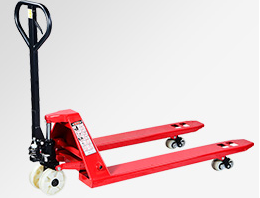
This process may seem simple, but it contains the efficient principle of hydraulic transmission. Compared to pure manual handling, manual hydraulic handling vehicles can significantly save time and energy, especially suitable for environments that require frequent handling and batch operations. Whether it's neatly stacked cardboard boxes in the warehouse or heavy metal parts in the workshop, it can move flexibly and operate accurately.
It can be said that manual hydraulic transport vehicles carry huge transportation needs with their small bodies. It is not only a skilled worker in the workplace, but also a practical partner for improving work efficiency and reducing labor intensity. Mastering its correct operation method can enable this' little earth cow 'to better serve daily work.