

News Details
Introduction to the Function of the Handle Device for Manual Hydraulic Transporters
Manual hydraulic handling vehicles can be called "little oxen" in the handling industry, with functions similar to forklifts. When handling large quantities and tonnages of goods in supermarkets, factories, etc., it can significantly save time and manpower and is a powerful assistant for cargo handling.
When using a manual hydraulic transport vehicle, the handle is an essential control device. Firstly, perform the cargo lifting operation: insert the fork under the cargo tray, keep the handle perpendicular to the ground, hold the steering handle with both hands, and activate the hydraulic actuator. The hydraulic actuator generates pressure, and by shaking the steering handle up and down and continuously pressing the handle, the hydraulic cylinder can be controlled to lift the chassis, thereby completing the lifting of the cargo.
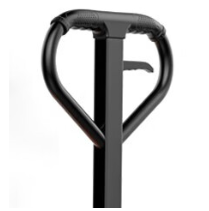
Next is the walking function: hold the tiller with both hands, rotate it clockwise by 90 degrees, and then press down on the tiller to form a certain angle with the ground. Pull out the handle with one hand and drive along the channel route.
After arriving at the destination, the landing operation is equally simple: hold the steering handle with both hands, keep it perpendicular to the ground, and turn off the hydraulic system. At this point, the pressure inside the hydraulic press disappears, and the tray will smoothly descend to the ground.
In short, the handle of a manual hydraulic transport vehicle is the main device for controlling the lifting of goods and the movement of the vehicle, providing us with great convenience in transporting goods.