

News Details
Characteristics description of polyurethane wheels for manual hydraulic handling vehicles
Manual hydraulic handling vehicle is a commonly used short distance handling equipment in current industrial scenarios, widely used in printing factories, food factories, logistics and express delivery, shopping mall workshops and other places. This device, when paired with pallets, can transport various heavy goods and is suitable for the vast majority of cargo handling scenarios. To adapt to different ground environments, manual hydraulic handling vehicles on the market are generally equipped with wheels made of different materials, among which polyurethane wheels and rubber wheels are the two most mainstream types.
At present, polyurethane wheels are gradually replacing traditional rubber wheels and becoming the preferred choice in the industry. Thanks to its special chemical structure, the rolling resistance of polyurethane wheels is much lower than that of rubber wheels, and its load-bearing performance is several times that of rubber wheels. At the same time, it has excellent tear resistance, better environmental friendliness, higher durability, and outstanding advantages in comprehensive use.
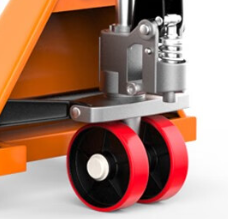
In terms of service life, the wear-resistant and wear resistant characteristics of polyurethane wheels make them significantly advantageous, with a theoretical service life of about 20 years. However, in practical work scenarios, its service life is not fixed and will be affected by multiple factors, among which cargo load, daily usage frequency, and working ground conditions are the core influencing factors.
To effectively extend the service life of polyurethane wheels and even the entire transport vehicle, reduce equipment wear and tear, it is recommended that users strictly follow operating procedures, eliminate overloading operations, adhere to scientific and rational use of equipment, and reduce unnecessary wear and damage.